


Stories We Have Preserved
The Bird Family - 2026
This commission spanned 18 months and explored four distinct family lines, tracing ancestry through both sides of the subject’s family. The result was a 262-page volume of more than 38,000 words, bringing together generations of documentary research, historical context and family narrative. What began as a collection of names, dates and partially known stories developed into a remarkably detailed account of lives stretching across centuries.
The research reached far beyond conventional census and civil registration records. One ancestral line was followed back into Tudor England, with the known Bird family traced to Broxton in Cheshire before later generations became established in Suffolk. Among the most rewarding discoveries was the 1627 will of Edmund Bird, a seventeenth-century Suffolk yeoman. The original document was located and transcribed, revealing that Edmund possessed a house and land and even preserving the deeply personal detail of a twenty-shilling bequest to his brother to purchase a ring in his memory. Another record placed Simon Bird in the 1727 Suffolk county poll, demonstrating that he held sufficient freehold property to qualify for the vote — the kind of discovery that allows us to understand not simply who an ancestor was, but something of his standing within his community.
As the research moved forward through the generations, the story changed dramatically. Rural Suffolk gave way to the streets and industries of London, while another branch led across the Irish Sea to the McCarthy and Hurley families of Skibbereen, County Cork, connecting the family directly with a community devastated by the Great Irish Famine and the migration that followed. Institutional records uncovered the extraordinary experiences of two young Russell brothers who entered Barnardo’s as children; their later lives included military service, the Second Boer War and the First World War. The research also reconstructed the story of eighteen-year-old George Albert Russell, a Royal Field Artillery driver sent to France in 1915, who died during the Battle of Loos only weeks after arriving on the Western Front.
What made this commission particularly compelling was the way apparently unrelated records gradually began to connect. Parish registers, wills, electoral records, census returns, military papers, institutional records and migration evidence each supplied another piece of the story. Rather than simply constructing a family tree, we were able to explore where these people lived, how they earned their living, why they moved, what historical events touched their lives and, occasionally, something of the people they were.
The finished volume transformed that research into a continuous family narrative — moving from Tudor and early modern England through rural Suffolk, famine-era Ireland, Victorian London and the upheavals of twentieth-century war. It demonstrates what detailed genealogical research can achieve when the aim is not merely to discover ancestors, but to restore context, individuality and meaning to lives that might otherwise survive only as names in a record.
Sayers & Goodridge Family History - 2024
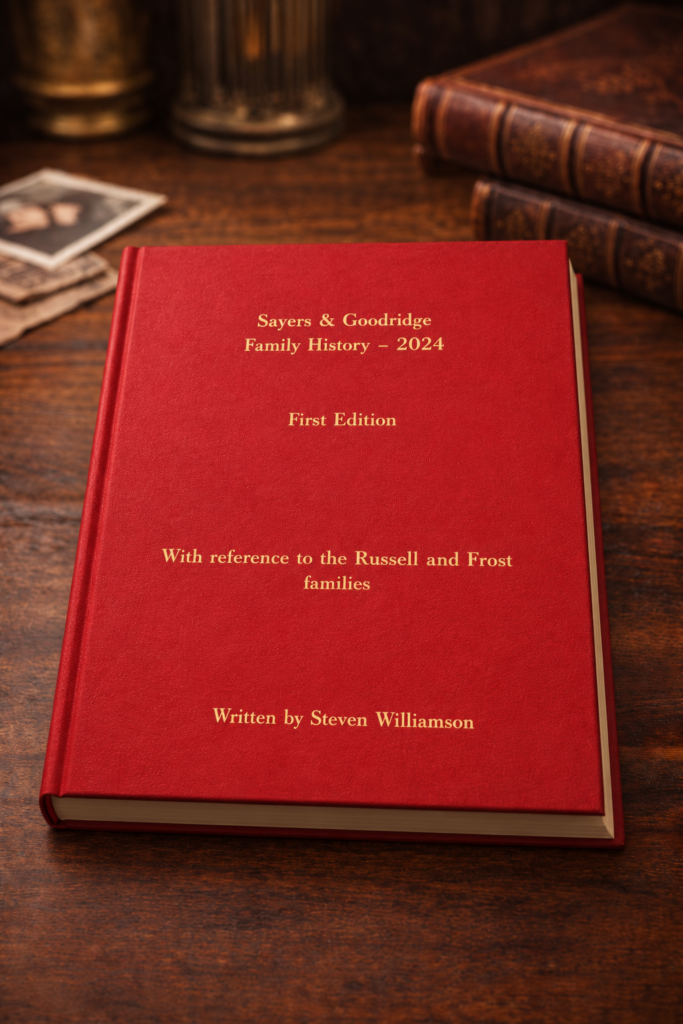
This commission spanned 18 months and explored four distinct family lines, tracing ancestry through each of the subject’s grandparent branches. The result was a 262-page volume of more than 38,000 words, bringing together genealogical evidence, historical research and narrative storytelling. Note: Our client requested Buckram Cloth for book.
One of the most rewarding discoveries began with something comparatively small: a clue within the subject’s DNA results suggesting French ancestry. On its own, that information could tell us little about the people behind it. However, as the documentary research progressed, distinctly French surnames began appearing within one branch of the family — including Prevost, Moules, L’Ami and Bourgeois.
Following those names backwards revealed a remarkable connection with London’s Huguenot community. Several ancestors had fled France following the persecution of French Protestants and established new lives in Spitalfields, where successive generations became part of the area’s flourishing French community. One line led to Adrien L’Ami and Marie LeMaire, both born in France, while another uncovered the Prevost family, whose descendants remained associated with Spitalfields for generations.
The records allowed us to go beyond simply identifying where these ancestors came from. We discovered that members of the L’Ami family were silk weavers specialising in silk handkerchiefs, working from Gun Street in Spitalfields — placing the family directly within one of the trades for which London’s Huguenot community became renowned.
What began as an indistinct percentage on a DNA test had therefore become something entirely different: named ancestors, places, occupations, migration and a connection to one of the most significant refugee communities in London’s history. It is an example of what detailed family-history research can achieve — transforming genetic clues into the lives of real people and placing those lives within the world they knew.
The completed research was preserved in a bespoke family-history volume, traditionally bound in buckram cloth and produced by Blissetts of London, creating a permanent record of discoveries that might otherwise have remained hidden within archives and databases.
Gough Family History – 2023
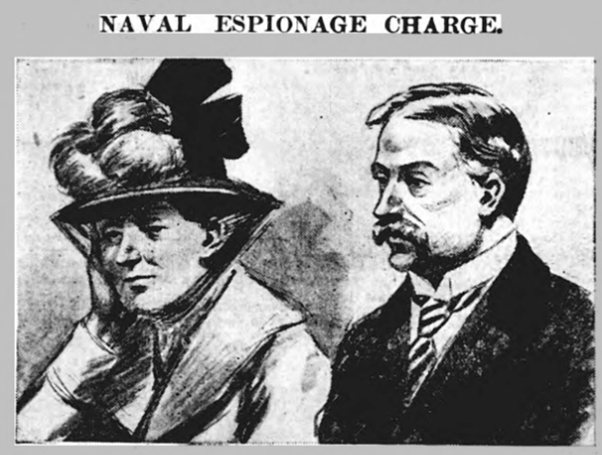
This commission followed a single direct paternal line through an extraordinary span of British history. Beginning with familiar twentieth-century records, the research moved backwards through generations of Black Country ironworkers, craftsmen and labourers before reaching Shropshire landowners, medieval Welsh families and, ultimately, genealogical traditions connected with the rulers of the ancient Kingdom of Powys.
The first major breakthrough came when conventional genealogical research reached Johannes ap Griffith, born around 1410 in Shropshire. Ordinarily, reaching the early fifteenth century would represent an exceptional result. In this case, however, Johannes appeared within the 1623 Visitation of Shropshire, where the pedigree of the “Goughs of the Marshe” preserved several earlier generations. That single historical source extended the family line back to approximately 1220 and opened an entirely new phase of research.
Further investigation into Welsh genealogical material revealed names and dates corresponding with pedigrees associated with medieval Powys. Working with historical studies and consulting Welsh historians allowed the research to explore the possibility that this line extended substantially further into the early medieval period, where successive generations appear among the lords, warriors and rulers associated with Powys. Because evidence of this age is very different from modern genealogical documentation, these earlier connections were considered through historical pedigrees, heraldry and specialist research rather than treated in the same way as a nineteenth-century birth certificate or census return.
One particularly compelling discovery concerned the origin of the Gough surname itself. The family had previously followed the Welsh patronymic tradition, with names such as ap Griffith — literally “son of Griffith”. The surname Gough first appears in the direct line with Johannes Gough, born in 1452. The Visitation of Shropshire also records heraldry associated with the Goughs of the Marshe, providing another fascinating link between the family’s Welsh origins and its later identity in Shropshire.
Not every discovery involved rank or heraldry. One medieval document produced a much darker story. A Latin coroner’s account described Jeuan ap Ryryd as a fugitive and felon of the King in connection with the death of his own brother. His goods and cattle were confiscated, and the episode coincides with the point at which the direct family line disappears from Wales and begins to appear across the border in Shropshire. The surviving evidence cannot tell us exactly what happened, but it transformed an otherwise anonymous medieval ancestor into the centre of a genuine historical mystery.
Perhaps the most striking aspect of the commission was the contrast between generations. Over the centuries, the family’s story moved away from land, manors and influence and towards skilled trades and industrial work. By the eighteenth century, one ancestor was a master bricklayer; later generations moved into Birmingham and the Black Country. The research uncovered a family button-making business in St Paul’s Square, followed eventually by agricultural implement makers, furnace workers and ironworkers in Darlaston as the Industrial Revolution transformed the region.
By the nineteenth century, the contrast was remarkable: descendants of a family once associated with Welsh lords and Shropshire landowners were working amid the furnaces, workshops and metal trades of industrial Darlaston. One ancestor spent around thirty years working at the blast furnaces, while his sons entered the same heavy industries that defined the Black Country.
The finished history therefore became much more than an extended pedigree. It followed the changing fortunes of one family across centuries — from medieval Wales to Shropshire manors, Georgian Birmingham and the furnaces of the Black Country — showing how political upheaval, migration, work, opportunity and individual decisions can completely transform a family over time.
You can read an extract of the book regarding the discovery of a German spy in the family.
The Cadman Family - 2023
This 153-page family history explored the Cadman line alongside the connected Williams, Adams and Lunn families, drawing on hundreds of records including parish registers, civil records, census returns, military documents, newspapers, local histories and archival material. What emerged was not simply a succession of ancestors, but a striking account of how one family adapted as Britain changed around them.
The confirmed Cadman line was traced to George Cadman, born in North Shropshire in 1648. Successive generations remained within the rural communities of Prees and Adderley before the Industrial Revolution changed the direction of the family. By the late eighteenth century, William Cadman had left Shropshire for Birmingham, beginning a gradual transformation from agricultural life to the trades and industries of the growing city. Later generations became deeply involved in Birmingham’s brass industry before the family eventually moved onwards towards West Bromwich.
Occasionally, archival research allowed us to move beyond knowing the name of a village and locate an ancestor much more precisely. A record held by the Shropshire Archives revealed that, at the age of twenty, William Cadman leased a property on Norton Lane, Adderley, from Sir Corbet of Adderley Hall. The surviving record even preserves the annual rent of one shilling, providing a rare glimpse of the family’s relationship with the estate on which they lived and worked. Discoveries such as this turn an ancestor from a name in a register into somebody who can be placed within a particular landscape and community.
One of the most poignant discoveries came through the Adams family. William Adams worked as an underground loader at Sandwell Park Colliery in West Bromwich. On 27 October 1894, an explosion tore through the mine. Evidence uncovered during the research suggests William was not even due to be working that day, but had entered the mine to take chalk to colleagues. He was killed in the disaster, leaving Sarah Ann to raise their young children without him.
A generation later, tragedy touched the family again. William’s son Walter Adams, who had followed his father into coal mining, served during the First World War and disappeared during the Battle of the Somme in July 1916. He was reported missing and subsequently regarded as killed during fighting around Pozières. Elsewhere in the family, brothers Francis and Samuel Whitehouse also served. Francis, a corporal in the South Staffordshire Regiment, was declared missing and dead during the First Battle of Ypres in November 1914 and is commemorated on the Menin Gate.
The research also uncovered stories that reveal a very different side of Black Country life. Generations of the Aston family were associated with innkeeping in Tipton, with licences traced from at least 1818 into the twentieth century across establishments including the Britannia Inn, Barge & Barrel, Cock & Wheatsheaf and numerous other local pubs. Another branch appeared in the 1767 Return of Papists, identifying several direct ancestors in Sedgley as Catholics at a time when their religion still attracted official suspicion and scrutiny.
Taken together, these discoveries created a family history rooted firmly in the social history of the Midlands: tenant farmers, brass workers, miners, publicans and soldiers whose individual lives intersected with some of the defining changes and events of their time. The commission demonstrates why family history can become so much richer when we move beyond dates and relationships and ask what the surviving evidence can tell us about how our ancestors actually lived.
Anslow Family - 2021
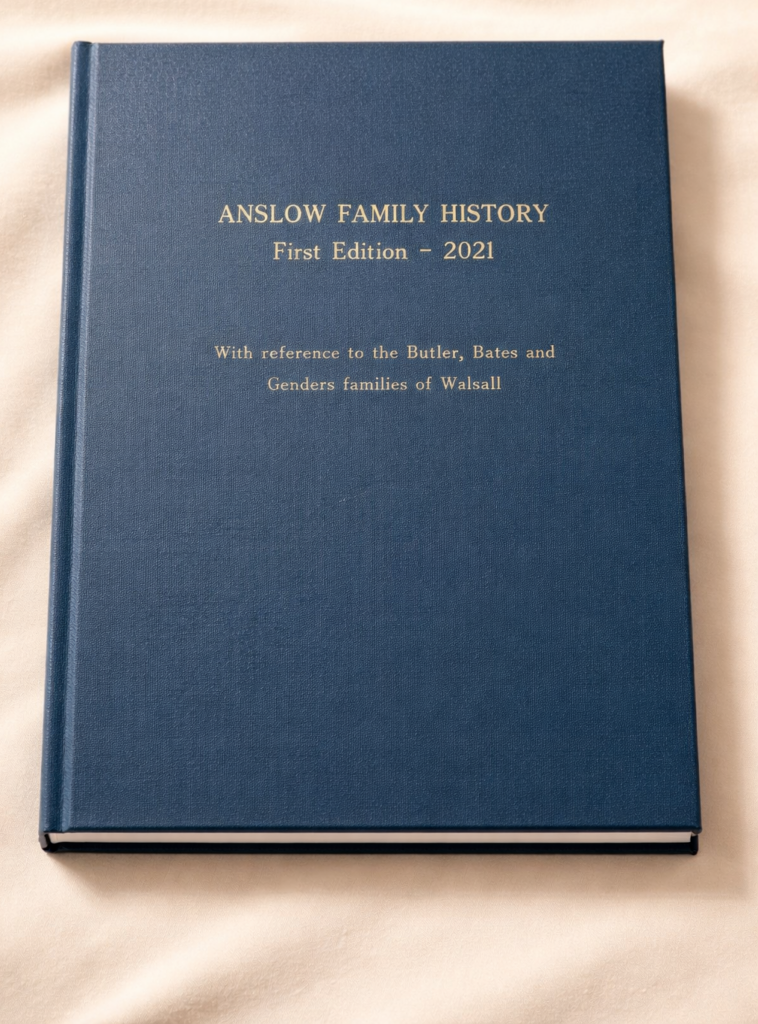
This nine-month commission explored two family lines in depth, resulting in a 198-page volume of over 31,000 words. Through detailed research, the family was traced back to the 1500s, reaching as far as 11th great-grandparents. Note: The client chose the book design.
What emerged was a rich and often unexpected story.
Among the most compelling discoveries was the story of Richard Ansley, a distant great-uncle within the direct Anslow line. Born in Oxfordshire in the early eighteenth century, Richard later emigrated with his family to Virginia. Research into subsequent generations revealed a remarkable connection with the developing Methodist movement in America, eventually leading to a descendant who married the Reverend Anderson Watson, a minister associated with the Wesley Chapel Methodist Episcopal Church in Georgia.
The discovery added an unexpected transatlantic dimension to a family whose direct ancestors had been rooted in Staffordshire for centuries. It also demonstrated how following the lives of siblings, cousins and extended relatives can illuminate the wider beliefs, migrations and social networks surrounding a direct ancestral line.
The research did not shy away from more difficult aspects of the family’s past. Records associated with Reverend Anderson Watson revealed slave ownership within this extended American branch, providing an important reminder that meaningful family history sometimes uncovers uncomfortable as well as celebratory discoveries.
Elsewhere, the commission followed generations of the Anslow family through Staffordshire and into Walsall, while also exploring the connected Butler, Bates and Genders families. These branches revealed deep links with the town and with the leather, saddlery and metalworking industries that shaped generations of working lives. The Butler family alone could be traced in Walsall to around 1700, with St Matthew’s Church remaining a focal point across generations.
Together, the research transformed a family tree containing names and dates into a broader story of faith, migration, industry, war and social change, preserving both the remarkable discoveries and the more complicated realities of the family’s past.